
Five Proofs of the Existence of God
by Edward Feser | 
Philosophers without Gods
by Louise M. Antony |
There Is a God
by Antony Flew |
Critique of Religion and Philosophy
by Walter Arnold Kaufmann | 
The Best Things in Life
by Peter Kreeft |
Atheism
by Michael Martin |
The Twilight of Atheism
by Alister McGrath |
From Religion to Philosophy
by Francis Macdonald Cornford |
The Devil's Delusion
by David Berlinski |
Why Atheism?
by George H. Smith |
Atheism
by George Hamilton Smith |
The Existence of God
by Richard Swinburne | 
Religion for Atheists
by Alain de Botton | 
Atheism
by Julian Baggini | 
Lament for a Son
by Nicholas Wolterstorff | 
Leaves from the Notebook of a Tamed Cynic
by Reinhold Niebuhr | 
Philosophy and Religion in the West
by Phillip Cary | 
The Tao Is Silent
by Raymond Smullyan | 
Theology of Hope
by Jurgen Moltmann | 
Dynamics of Faith
by Paul Tillich |
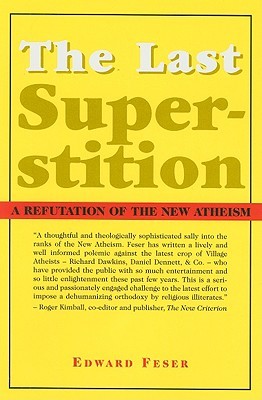 "The central contention of the "New Atheism" of Richard Dawkins, Daniel Dennett, Sam Harris, and Christopher Hitchens is that the centuries-old "war between science and religion" is now over and that religion has lost. But as Edward Feser shows in The Last Superstition, there is not, and never has been, any war between science and religion at all. There has instead been a conflict between two entirely philosophical worldviews: the classical "teleological" vision of Plato, Aristotle, Augustine, and Aquinas, on which purpose or goal-directedness is as inherent a feature of the material world as mass or electric charge; and the modern "mechanical" vision of Descartes, Hobbes, Locke, and Hume, according to which physical reality is comprised of nothing more than purposeless, meaningless particles in motion." "This modern "mechanical" view of nature has never been proved, and its hold over the contemporary intelligentsia owes more to rhetorical sleight-of-hand and political expediency than to rational argument. For as Feser demonstrates, the existence of God, the immortality of the soul, and the traditional natural-law conception of morality are rationally unavoidable given the classical "teleological" philosophical world-view. Hence modern secularism crucially depends on the false insinuation that the "mechanical" philosophy has somehow been established by science." Moving beyond what he regards as the pointless and point-missing dispute between "Intelligent Design" advocates and Darwinians, Feser holds that the key to understanding the follies of the "New Atheism" lies not in quibbles over the evolutionary origins of this or that biological organ, but in a rethinking of thephilosophical presuppositions of scientific method itself back to first principles. In particular, it involves a recovery of the forgotten truths of classical philosophy. When this is accomplished, religion can be seen to be grounded firmly in reason, not blind faith. And despite its moral and intellectual pretensions, the "New Atheism" is exposed as resting on very old errors, together with an appalling degree of intellectual dishonesty, philosophical shallowness, and historical, theological, and scientific ignorance.